
Tree services
Tree cutting services
Tree cutting is the work of bringing a tree down safely. With open space, a tree can be felled in one piece using a notch and a hinge of wood that steers its fall. Near houses, fences or lines, it's cut down in sections from the top, with heavy pieces lowered on ropes. Choosing the method is the most important decision in the job.
By calling, you agree that your call may be recorded and routed to an independent local tree-service provider, who may call or text you back about your request. Calling is free and does not obligate you to hire anyone. See our Privacy Policy.
Who needs tree cutting
Bringing a tree down safely: felled in one piece or cut down in sections.
Often needed with: tree removal, large tree removal, stump grinding & removal, emergency tree cutting.
Call and we'll connect you with a tree-service provider for tree cutting in your area.
Call for tree serviceWhat to confirm in a tree cutting quote
Quotes differ mostly in what they include. Ask each provider to put these in writing so you can compare like for like:
- Felled in one piece or taken down in sections, and why
- What's protected under the tree
- Wood: cut to firewood length and left, or hauled
- Brush chipped or hauled
- Whether stump grinding is included
Last updated
When a tree needs cutting down
- The tree is dead, dying or structurally unsound and has to come down.
- It's too close to a house, foundation or septic system.
- You're clearing room for a building, driveway or garden.
- A tree is leaning more each year toward something it could hit.
- You need a tree cut down and left as logs or firewood rather than fully hauled.
How a tree is cut down
- 1
Plan the fall or the drops
The crew reads the lean, wind, defects and targets, and decides whether to fell or dismantle.
- 2
Clear the work zone
People, vehicles and anything movable are kept out of the area the tree or its pieces could reach.
- 3
Cut
For felling, a face notch and back cut leave a hinge that steers the tree; for dismantling, limbs and trunk sections are cut and lowered on ropes.
- 4
Buck the wood
The trunk and big limbs are cut into lengths you can use as firewood or that can be hauled.
- 5
Clean up as agreed
Brush is chipped or hauled and wood is stacked or removed, depending on the quote.
Felling vs. cutting in sections
Felling brings the tree down in one piece. The cutter makes a face notch on the side the tree should fall toward and a back cut from the other side, leaving a strip of uncut wood called the hinge that steers the fall. It's fast and economical, but only where there's a clear landing zone longer than the tree is tall.
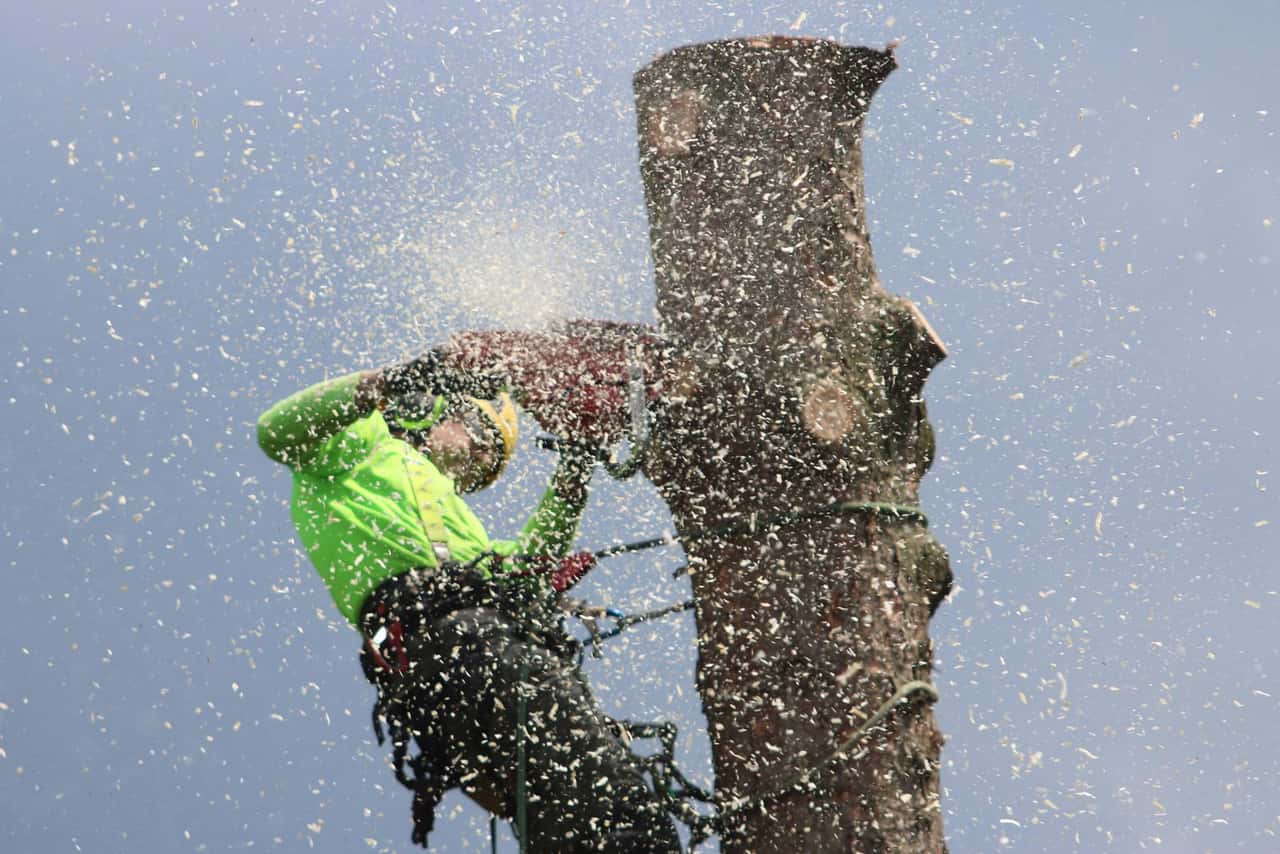
Sectional dismantling takes the tree apart from the top: limbs first, then the trunk in short lengths. Pieces are lowered on ropes through blocks and friction devices, or lifted out by crane. It's slower, but it's how trees next to houses, fences and lines are cut down.
Why DIY tree cutting goes wrong
The most serious accidents happen at the stump: a tree that falls the wrong way because of lean or a bad hinge, a trunk that splits upward during the back cut (a barber chair), or a saw that kicks back. Trees with lean, decay or storm tension make every one of those more likely.
Professional crews work to the ANSI Z133 safety standard, wear cut-resistant gear, and plan escape routes before cutting. If the tree could reach anything you care about, it's a job for them.
Getting the site ready
Safe for a homeowner
- Keep everyone back at least twice the tree's height while it's being cut.
- Move cars and outdoor furniture out of the area before the crew arrives.
- Decide ahead of time whether you want to keep the wood.
Leave these to professionals
- Don't cut a tree that's leaning toward a house, line or road yourself.
- Don't cut trees that are bent or pinned under tension after a storm; they can spring back violently.
- Don't work within 10 feet of power lines; only qualified line-clearance workers can.
What it costs to cut a tree down
What it costs to cut a tree down depends mostly on whether it can be felled or must be dismantled:
- Whether the tree can be felled or must be dismantled
- Height and trunk diameter
- Targets under and around it
- Access for equipment such as lifts or cranes
- Whether you keep the wood or want everything hauled
- Stump grinding, if you want it done the same day
Keeping the wood
Asking the crew to leave the wood can lower the bill. Specify the length you want (firewood rounds, or longer logs if you'll split them yourself) and where it should be stacked.
Don't move firewood long distances. Invasive pests such as emerald ash borer travel in firewood, and many states restrict moving it.
Tree cutting questions
What's the difference between tree cutting and tree removal?
Tree cutting is bringing the tree down. Tree removal usually means the whole service: cutting, hauling the wood and brush, cleanup and often stump grinding. Ask what's included so you can compare bids.
How much room do you need to fell a tree in one piece?
A clear landing zone longer than the tree is tall in the planned direction, plus room to the sides for the crown and a clear escape path for the cutter. If that space doesn't exist, the tree is taken down in sections.
Is it safe to fell a small tree on my own?
Small trees in open ground, maybe, with proper protective gear and chainsaw skills. Anything near a structure, leaning, damaged, or over about the height of a one-story house is where DIY cutting most often goes wrong.
What is a barber chair?
A dangerous failure where the trunk splits vertically during the back cut and the butt kicks up or out toward the cutter. It's most likely on leaning trees and is prevented with the right cutting technique.
Can I keep the wood from my tree?
Yes. Ask the crew to cut the trunk and big limbs to firewood length and leave them stacked; it often reduces the price because there's less to haul.
Do I need a permit to cut down a tree?
In many cities, yes, for trees above a certain trunk size or for protected species. Rules vary widely, so check the local rules before cutting. See tree removal permits.
What's the best time of year to cut a tree down?
Dormant season is often easier: no leaves add weight, and frozen or dry ground is less damaged by equipment. For red oaks in oak wilt areas, avoid cutting and wounding in spring and early summer when the disease spreads.
Will cutting a tree leave a stump?
Yes. Cutters leave a stump a few inches high unless it's ground or removed afterward. Stump grinding is usually quoted separately.
Is cutting limbs off a tree the same as tree cutting?
Cutting off limbs to keep the tree is pruning or trimming, which follows different rules about where and how much to cut so the tree stays healthy.
What tree cutting can include
- Assessment
- What the tree could hit, its condition, and access.
- Job planning
- Whether it can be felled or must come down in sections.
- Sectional removal and rigging
- Limbs and trunk lowered on ropes near buildings.
- Crane work when needed
- For big or decayed trees over structures.
- Brush and debris cleanup
- Chipping branches and raking the work area.
- Wood hauling or leaving rounds
- Agree in advance which you want.
- Stump options
- Grinding is usually a separate line item.
- Property protection
- Mats, plywood or careful drops to protect lawns and drives.
Before you call about tree cutting
These answers let a provider tell you on the first call what the job involves and roughly how it'll be done.
- Height and trunk width
- Taller than the house?
- Space around it
- Room to fell, or tight?
- What it could hit
- House, fence, lines, neighbor
- Lean and condition
- Dead, leaning, damaged?
- The wood
- Keep it or haul it
Safety and permission checks
- Power lines: stay at least 10 feet from overhead lines (OSHA's minimum distance for unqualified workers) and call the utility; only line-clearance-qualified tree workers cut closer.
- Underground lines: call 811 a few days before stump grinding or digging so buried utilities are marked for free.
- Permits: ask the city or county before removing or heavily pruning a large tree; protected-tree sizes and street-tree rules vary by place.
- Who is responsible: a tree on your lot is usually yours, street (right-of-way) trees are usually the city's, and trees on lines are the utility's to clear.
- Doing it yourself: picking up small fallen limbs is a homeowner job; chainsaw work off a ladder, near lines or on anything that could hit a building is not.
Have your answers ready? Call and we'll connect you with a provider serving your area.
Call for tree serviceHow getting tree cutting works
- 1
Tell us what's happening
Call and describe the tree, where it is and how urgent it is.
- 2
Get connected
Your call goes to an independent tree-service provider serving your area.
- 3
The tree is assessed
The provider looks at the tree, what's around it, and access for equipment.
- 4
Scope and price are discussed
You get the plan and price directly from the provider, before any work.
- 5
You decide
There's no obligation; you choose whether and when to go ahead.
TreeRemovalServices.net is a referral service and doesn't perform tree work. How it works
Related tree services
- Tree Removal servicesTaking down a tree you no longer want or can't keep, in sections near buildings.
- Large Tree Removal servicesBig trees close to structures that need rigging or a crane.
- Stump Grinding & Removal servicesGrinding stumps below grade so you can replant, sod or build.
- Emergency Tree Cutting servicesCutting a fallen tree off a car, driveway, fence or road.
- Emergency Tree Removal servicesA tree on the house, car, driveway or a line, or one about to fall.
- Storm Damage Tree Removal servicesUprooted, split or snapped trees and hanging limbs after wind, ice or hurricanes.
- Tree Trimming & Pruning servicesPruning for clearance over roofs and drives, deadwood removal and storm preparation.
- Dead Tree Removal servicesDead or dying trees that turn brittle and get riskier to climb every season.
- Hazardous Tree Removal servicesLeaning, cracked or decayed trees that could hit something if they fail.
- Tree Risk Assessment servicesAn arborist's opinion on whether a tree can stay, before you remove it.
- Commercial Tree ServicesTree work for HOAs, property managers and commercial sites.
- Land Clearing servicesClearing brush, trees and stumps from a lot by mulching or excavation.
- Stump Removal servicesDigging out the stump and root ball where something will be built or planted.
- Palm Tree Removal servicesDead, diseased or unwanted palms, crown first, then the trunk.
- Oak Tree Removal servicesOaks with permits, oak wilt timing and heavy wood to plan around.
- Pine Tree Removal servicesTall, beetle-killed or storm-damaged pines near the house.
- Emergency Tree Trimming servicesBroken, hanging or cracked limbs over a roof, drive or path.
Tell us what's happening and we'll connect you with a tree-service provider serving your area.
Call for tree serviceWhy these services go together
- Tree Removal: the full service including hauling and cleanup
- Large Tree Removal: when cranes or heavy rigging are needed
- Stump Grinding & Removal: to finish the job below grade
- Emergency Tree Cutting: for trees down or pinned after a storm
Before a tree is cut down
Tree Cutting by location
By state (51)
- Texas
- Florida
- California
- Arizona
- Georgia
- North Carolina
- Washington State
- Minnesota
- New York
- Colorado
- Illinois
- Ohio
- Pennsylvania
- Michigan
- Tennessee
- Louisiana
- Missouri
- Virginia
- Maryland
- Washington, DC
- New Jersey
- Massachusetts
- Wisconsin
- Kentucky
- South Carolina
- Alabama
- Oklahoma
- Oregon
- Utah
- Indiana
- Nevada
- Iowa
- Arkansas
- Mississippi
- Kansas
- Connecticut
- New Mexico
- Idaho
- Nebraska
- Alaska
- Delaware
- Hawaii
- Maine
- Montana
- New Hampshire
- North Dakota
- Rhode Island
- South Dakota
- Vermont
- West Virginia
- Wyoming
By city (57)
- Dallas, TX
- Houston, TX
- Austin, TX
- San Antonio, TX
- Miami, FL
- Orlando, FL
- Tampa, FL
- Los Angeles, CA
- San Diego, CA
- Sacramento, CA
- Phoenix, AZ
- Atlanta, GA
- Charlotte, NC
- Raleigh, NC
- Seattle, WA
- Minneapolis, MN
- New York City, NY
- Denver, CO
- Chicago, IL
- Columbus, OH
- Cleveland, OH
- Philadelphia, PA
- Pittsburgh, PA
- Detroit, MI
- Nashville, TN
- New Orleans, LA
- St. Louis, MO
- Kansas City, MO
- Fort Worth, TX
- Jacksonville, FL
- Virginia Beach, VA
- Baltimore, MD
- Jersey City, NJ
- Boston, MA
- Milwaukee, WI
- Louisville, KY
- Charleston, SC
- Birmingham, AL
- Tulsa, OK
- Cincinnati, OH
- Memphis, TN
- Richmond, VA
- Fort Lauderdale, FL
- Tucson, AZ
- Portland, OR
- Salt Lake City, UT
- Indianapolis, IN
- Las Vegas, NV
- Tacoma, WA
- San Jose, CA
- San Francisco, CA
- Buffalo, NY
- Cedar Rapids, IA
- Wichita, KS
- Albuquerque, NM
- Boise, ID
- Omaha, NE
By county (14)
By town and neighborhood (8)
Need help with a tree?
Call to speak with a local tree-service provider about removal, trimming, stumps or storm damage. Describe the tree and what it's near, and they'll explain the next step.
By calling, you agree that your call may be recorded and routed to an independent local tree-service provider, who may call or text you back about your request. Calling is free and does not obligate you to hire anyone. See our Privacy Policy.