
Tree services
Land clearing and lot clearing services
Land clearing removes trees, brush and stumps from a lot so it can be built on, fenced, farmed or simply used again. The two main methods are forestry mulching, which grinds vegetation in place and leaves a mulch layer, and excavator clearing, which pulls trees and roots out so the ground can be graded. Which one fits depends on what comes next on the land.
By calling, you agree that your call may be recorded and routed to an independent local tree-service provider, who may call or text you back about your request. Calling is free and does not obligate you to hire anyone. See our Privacy Policy.
Who needs land clearing
Clearing brush, trees and stumps from a lot by mulching or excavation.
Often needed with: stump removal, stump grinding & removal, tree cutting, commercial tree services.
Call and we'll connect you with a tree-service provider for land clearing in your area.
Call for tree serviceWhat to confirm in a land clearing quote
Quotes differ mostly in what they include. Ask each provider to put these in writing so you can compare like for like:
- The exact area, marked on a site plan or on the ground
- Method: forestry mulching or excavator clearing
- Whether stumps and roots come out or stay at grade
- Debris plan: mulched, hauled, sold or burned under permit
- Trees to keep, and how their root zones are protected
- Erosion control and who pulls permits
Last updated
When a lot needs clearing
- A lot is too overgrown to walk, survey or market.
- You're preparing a building pad, driveway or septic area.
- A fence line or property boundary is lost under brush and saplings.
- Pasture or open ground is being taken over by brush and young trees.
- Invasive shrubs or vines have taken over part of the property.
- The county or HOA has cited an overgrown vacant lot.
Forestry mulching or excavator clearing?
Forestry mulching grinds brush and small trees where they stand and leaves a mulch layer that protects the soil. It's quick, there's little to haul, and it suits fence lines, trails, pasture and lots that won't be built on right away. It leaves roots and stumps at grade.
Excavator clearing fells trees and pulls out stumps and roots so the ground can be graded and built on. It disturbs more soil, creates more debris to handle, and needs erosion control afterward, but it's what a slab, driveway or septic field needs.
How a clearing job runs
- 1
Walk the site and mark limits
The property line, trees to keep, wet areas and anything buried are marked before machines arrive.
- 2
Call 811 and check permits
Underground utilities are located, and any grading, tree or land-disturbance permits are confirmed with the city or county.
- 3
Clear
A forestry mulcher grinds brush and small trees in place, or excavators and skid steers fell trees and pull stumps and roots.
- 4
Handle debris
Material is mulched on site, chipped, hauled, or burned only where a burn permit allows it.
- 5
Stabilize the ground
Silt fence, seed, straw or mulch keeps bare soil from washing off the site until it's built on or replanted.
Permits, wetlands and nesting birds
Many cities and counties require tree, grading or land-disturbance permits once clearing passes a certain area, and some protect large trees even on vacant land. Check with the planning or building office before work starts.
Wetlands are the most expensive mistake in land clearing. Clearing or filling them can require a permit under Section 404 of the Clean Water Act plus state approval. Active nests of most native birds are protected under the Migratory Bird Treaty Act, which is why many clearing jobs are scheduled outside the main nesting season.
What drives the price of clearing land
Land clearing is priced by area and density, then adjusted for what has to happen to the stumps and debris:
- Acreage and how dense the vegetation is
- Tree sizes, since large trees may need felling crews before the machines
- Whether stumps and roots must come out or can be mulched at grade
- Slope, soft ground, rock and access for tracked equipment
- Debris plan: mulch left on site, hauled away, or burned under permit
- Erosion control the site plan or permit requires
Protecting the ground and the trees you keep
Safe for a homeowner
- Mark trees you want kept with ribbon and point them out on site.
- Find your survey or corner pins before the crew arrives.
- Ask the county whether part of the land is wetland or floodplain before clearing it.
Leave these to professionals
- Don't clear up to a line you aren't sure of; a survey is cheaper than a dispute.
- Don't burn brush piles without checking burn bans and permits.
- Don't fill or clear wetlands without the right permits; federal and state rules can apply.
What happens to the debris
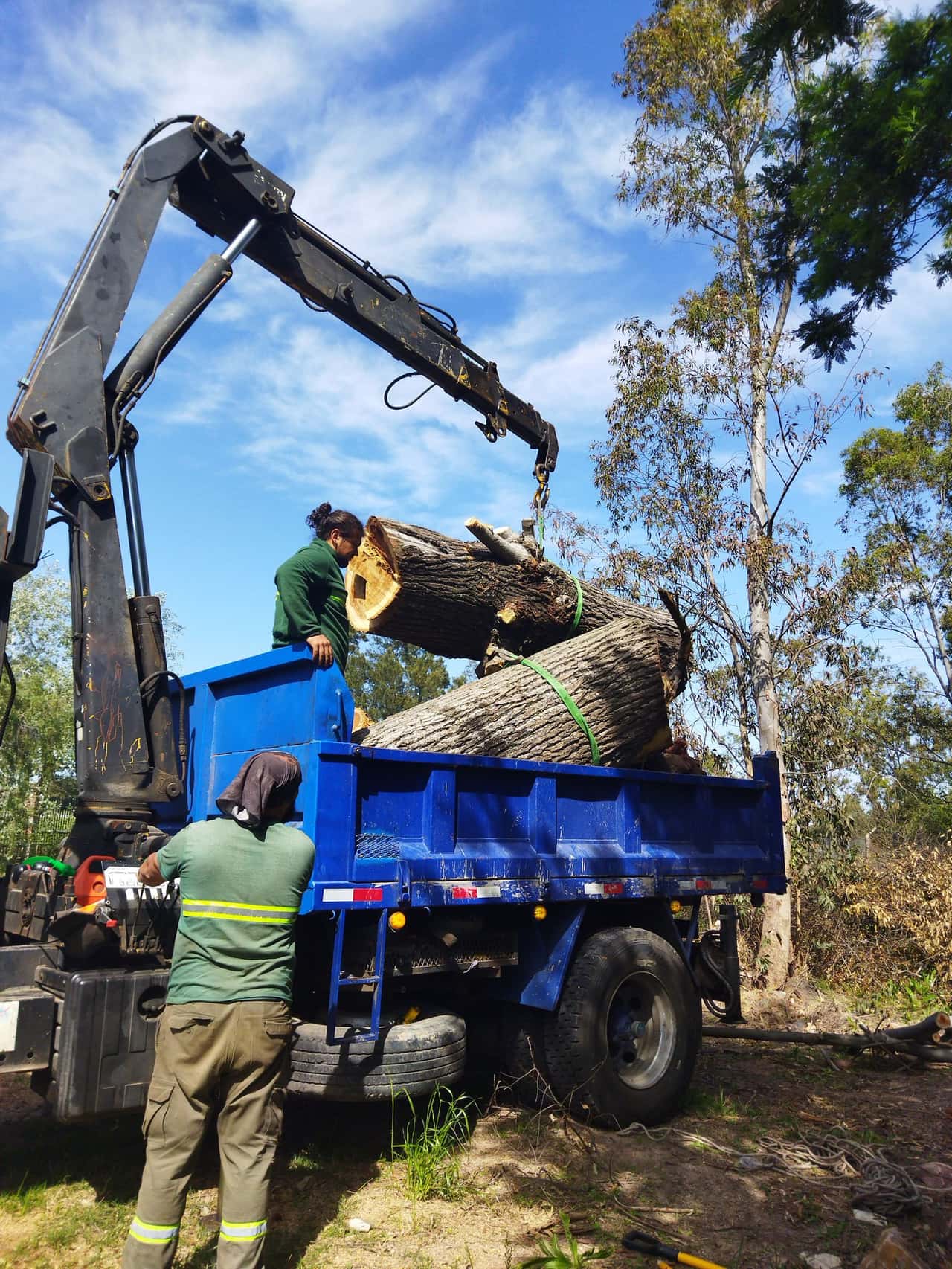
The debris plan is often the biggest difference between land clearing bids. Mulching in place leaves nothing to haul. Chipping produces material that can be spread or hauled. Logs from larger trees can sometimes be sold. Burning brush piles is cheap where it's allowed but usually needs a burn permit and is banned during dry spells.
Get the plan in writing: what's left on site, what's hauled, and what condition the ground will be in when the crew leaves.
Land clearing questions
What is forestry mulching?
A tracked machine with a rotating drum grinds standing brush and small trees into mulch where they stand. It's fast, leaves no piles to haul, and the mulch layer helps hold soil. It doesn't remove roots, so it suits fence lines, trails, pasture and lots that won't be graded right away.
Do I need a permit to clear land?
Often, depending on where you are and how much ground you disturb. Many cities and counties require tree removal, grading or land-disturbance permits above a certain area, and wetlands can need state or federal permits. Check with the local planning or building office first.
Can I clear land if there are wetlands on it?
Placing fill or clearing in wetlands can require a permit under Section 404 of the Clean Water Act and state rules. If any part of the lot stays wet, has standing water or wetland plants, get it checked before clearing.
What about birds nesting in the trees?
Active nests of most native birds are protected under the federal Migratory Bird Treaty Act. Many clearing jobs are scheduled outside the main nesting season, or the site is checked for active nests first.
Should stumps be removed when clearing a lot?
If the area will be built on, paved or graded, yes, because roots rot and leave voids that settle. For pasture, trails or fence lines, mulching stumps at ground level is usually enough.
What happens to all the wood?
It can be mulched in place, chipped and hauled, sold as logs if there's merchantable timber, or burned where a permit allows it. Ask for the debris plan in writing, because it's one of the biggest price differences between bids.
How long does land clearing take?
It depends on area, density and method. A mulching crew can often clear an overgrown residential lot in a day or two, while a wooded building site with stump removal and grading takes longer.
Will clearing cause erosion?
Bare soil washes away in heavy rain and can foul streets, drains and neighbors' yards. Silt fence, seeding, straw or the mulch layer from forestry mulching keep it in place, and many permits require these measures.
Can some trees be saved during land clearing?
Yes. Mark them clearly and ask the crew to protect the ground under their canopy, because machines compacting the root zone can kill a tree that wasn't touched.
Is land clearing the same as tree removal?
No. Tree removal takes down individual trees near homes, usually with climbers and rigging. Land clearing treats an area, with machines, and is priced by acreage and density rather than tree by tree.
Before you call about land clearing
These answers let a provider tell you on the first call what the job involves and roughly how it'll be done.
- Area
- Rough acreage or lot size
- What's growing
- Brush, saplings, large trees
- What it's for
- Building pad, fence line, pasture, sale
- Wet areas
- Standing water or creeks
- Access
- Gate width and road for a tracked machine
- Survey
- Do you know where the lines are?
Safety and permission checks
- Power lines: stay at least 10 feet from overhead lines (OSHA's minimum distance for unqualified workers) and call the utility; only line-clearance-qualified tree workers cut closer.
- Underground lines: call 811 a few days before stump grinding or digging so buried utilities are marked for free.
- Permits: ask the city or county before removing or heavily pruning a large tree; protected-tree sizes and street-tree rules vary by place.
- Who is responsible: a tree on your lot is usually yours, street (right-of-way) trees are usually the city's, and trees on lines are the utility's to clear.
- Doing it yourself: picking up small fallen limbs is a homeowner job; chainsaw work off a ladder, near lines or on anything that could hit a building is not.
Have your answers ready? Call and we'll connect you with a provider serving your area.
Call for tree serviceHow getting land clearing works
- 1
Tell us what's happening
Call and describe the tree, where it is and how urgent it is.
- 2
Get connected
Your call goes to an independent tree-service provider serving your area.
- 3
The tree is assessed
The provider looks at the tree, what's around it, and access for equipment.
- 4
Scope and price are discussed
You get the plan and price directly from the provider, before any work.
- 5
You decide
There's no obligation; you choose whether and when to go ahead.
TreeRemovalServices.net is a referral service and doesn't perform tree work. How it works
Related tree services
- Stump Removal servicesDigging out the stump and root ball where something will be built or planted.
- Stump Grinding & Removal servicesGrinding stumps below grade so you can replant, sod or build.
- Tree Cutting servicesBringing a tree down safely: felled in one piece or cut down in sections.
- Commercial Tree ServicesTree work for HOAs, property managers and commercial sites.
- Tree Removal servicesTaking down a tree you no longer want or can't keep, in sections near buildings.
- Emergency Tree Removal servicesA tree on the house, car, driveway or a line, or one about to fall.
- Storm Damage Tree Removal servicesUprooted, split or snapped trees and hanging limbs after wind, ice or hurricanes.
- Tree Trimming & Pruning servicesPruning for clearance over roofs and drives, deadwood removal and storm preparation.
- Dead Tree Removal servicesDead or dying trees that turn brittle and get riskier to climb every season.
- Hazardous Tree Removal servicesLeaning, cracked or decayed trees that could hit something if they fail.
- Large Tree Removal servicesBig trees close to structures that need rigging or a crane.
- Tree Risk Assessment servicesAn arborist's opinion on whether a tree can stay, before you remove it.
- Palm Tree Removal servicesDead, diseased or unwanted palms, crown first, then the trunk.
- Oak Tree Removal servicesOaks with permits, oak wilt timing and heavy wood to plan around.
- Pine Tree Removal servicesTall, beetle-killed or storm-damaged pines near the house.
- Emergency Tree Trimming servicesBroken, hanging or cracked limbs over a roof, drive or path.
- Emergency Tree Cutting servicesCutting a fallen tree off a car, driveway, fence or road.
Tell us what's happening and we'll connect you with a tree-service provider serving your area.
Call for tree serviceWhy these services go together
- Stump Removal: when roots must come out for a slab or driveway
- Stump Grinding & Removal: for scattered stumps on a lot that's otherwise open
- Tree Cutting: for large trees that need felling before machines go in
- Commercial Tree Services: for developers and HOAs with ongoing work
Before clearing a lot
Land Clearing by location
By state (51)
- Texas
- Florida
- California
- Arizona
- Georgia
- North Carolina
- Washington State
- Minnesota
- New York
- Colorado
- Illinois
- Ohio
- Pennsylvania
- Michigan
- Tennessee
- Louisiana
- Missouri
- Virginia
- Maryland
- Washington, DC
- New Jersey
- Massachusetts
- Wisconsin
- Kentucky
- South Carolina
- Alabama
- Oklahoma
- Oregon
- Utah
- Indiana
- Nevada
- Iowa
- Arkansas
- Mississippi
- Kansas
- Connecticut
- New Mexico
- Idaho
- Nebraska
- Alaska
- Delaware
- Hawaii
- Maine
- Montana
- New Hampshire
- North Dakota
- Rhode Island
- South Dakota
- Vermont
- West Virginia
- Wyoming
By city (57)
- Dallas, TX
- Houston, TX
- Austin, TX
- San Antonio, TX
- Miami, FL
- Orlando, FL
- Tampa, FL
- Los Angeles, CA
- San Diego, CA
- Sacramento, CA
- Phoenix, AZ
- Atlanta, GA
- Charlotte, NC
- Raleigh, NC
- Seattle, WA
- Minneapolis, MN
- New York City, NY
- Denver, CO
- Chicago, IL
- Columbus, OH
- Cleveland, OH
- Philadelphia, PA
- Pittsburgh, PA
- Detroit, MI
- Nashville, TN
- New Orleans, LA
- St. Louis, MO
- Kansas City, MO
- Fort Worth, TX
- Jacksonville, FL
- Virginia Beach, VA
- Baltimore, MD
- Jersey City, NJ
- Boston, MA
- Milwaukee, WI
- Louisville, KY
- Charleston, SC
- Birmingham, AL
- Tulsa, OK
- Cincinnati, OH
- Memphis, TN
- Richmond, VA
- Fort Lauderdale, FL
- Tucson, AZ
- Portland, OR
- Salt Lake City, UT
- Indianapolis, IN
- Las Vegas, NV
- Tacoma, WA
- San Jose, CA
- San Francisco, CA
- Buffalo, NY
- Cedar Rapids, IA
- Wichita, KS
- Albuquerque, NM
- Boise, ID
- Omaha, NE
By county (14)
By town and neighborhood (8)
Need help with a tree?
Call to speak with a local tree-service provider about removal, trimming, stumps or storm damage. Describe the tree and what it's near, and they'll explain the next step.
By calling, you agree that your call may be recorded and routed to an independent local tree-service provider, who may call or text you back about your request. Calling is free and does not obligate you to hire anyone. See our Privacy Policy.